Development & Deployment
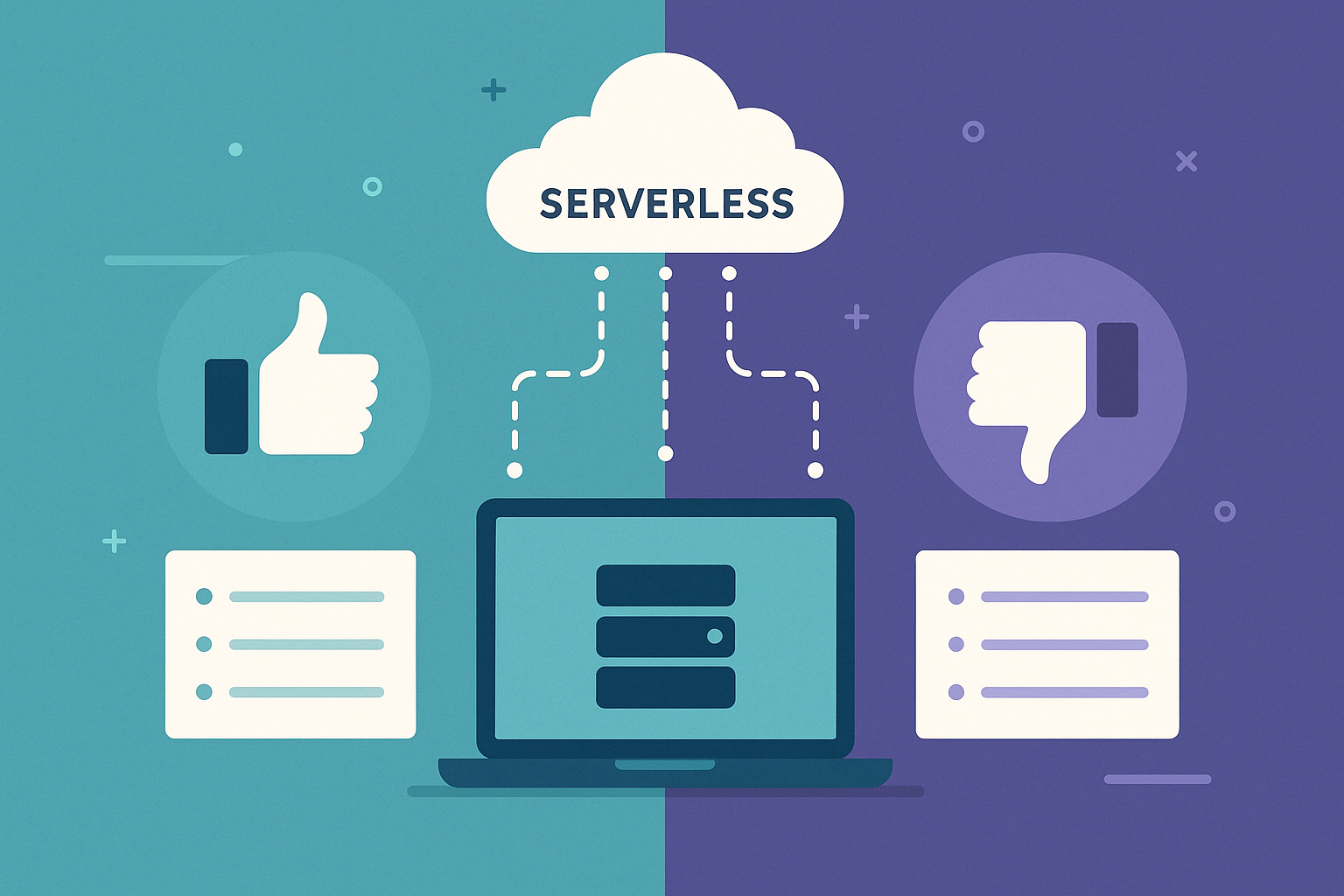
Serverless advantages and disadvantages for a web project
When to adopt, common pitfalls and cost/latency trade-offs.
O
Online Toolset TeamEditorial Team
6 min read
Serverless runs code on demand without managing servers. Great for variable workloads, it reduces ops overhead but comes with trade-offs (cold starts, runtime limits, vendor lock-in).
Typical use cases
- Event/webhook handlers (Stripe, Shopify, GitHub), async tasks, CRON.
- Ad-hoc data processing (image/video, light ETL), backends with intermittent traffic.
- Edge functions for personalization (A/B testing, geo routing, response rewriting).
Pros
- Pay-as-you-go: billed by execution time and invocations.
- Automatic scaling and high availability managed by the provider.
- Faster time-to-market: no server/OS patching or provisioning.
- Managed integrations (queues, events, secrets, schedulers).
Cons and limitations
- Cold starts and variable latency (especially outside edge runtimes). Mitigations: provisioned concurrency, warming.
- Limits: max duration (e.g., 15 min), memory/CPU, package size, outbound connections.
- Observability/debug is harder (distributed logs, tracing). You’ll want APM tools.
- Vendor lock-in and API differences (IAM, events, packaging).
- Unpredictable costs during traffic spikes; network egress can dominate.
Cost tip: estimate monthly cost with realistic assumptions (invocations x duration x memory) and compare to an equivalent container/VM. For steady, high traffic, containers can be cheaper.
Key tools and ecosystem
- Providers: AWS Lambda + API Gateway, Azure Functions, Google Cloud Functions/Run, Cloudflare Workers/D1/Queues.
- Platforms: Vercel Functions/Edge, Netlify Functions, Supabase Edge Functions.
- Frameworks: Serverless Framework, AWS SAM, SST, Next.js (Route Handlers, Middleware), Remix, Astro.
- Observability: AWS X-Ray, CloudWatch Logs, Datadog, New Relic, OpenTelemetry.
- Messaging/Events: SQS, SNS, EventBridge, Pub/Sub, Cloud Tasks, Cloudflare Queues.
Best practices
- Keep functions small and idempotent; externalize state (DB, queues, cache).
- Reduce cold start: fast runtimes (Node.js, Deno, Bun), slim dependencies, shared layers.
- Use provisioned concurrency for critical endpoints; tune timeouts/memory and control retries.
- Security: least privilege (IAM), secrets via KMS/Parameter Store/Secrets Manager.
- Observability: trace correlation, custom metrics, DLQs for async errors.
When to use / avoid
- Use for: variable traffic, MVPs, event-driven jobs, backend automation, batch processing.
- Avoid for: consistently ultra-low latency, long-lived sockets, continuous CPU/GPU intensive workloads.
Alternatives and hybrids
- Managed containers (Cloud Run, App Runner) to avoid severe cold starts with minimal ops.
- Hybrid: critical endpoints on containers, the rest on functions; edge for personalization.
Resources
- AWS Lambda pricing calculator, AWS/Azure/GCP docs.
- Serverless Framework and SST docs, Vercel/Netlify guides.
ServerlessAWS LambdaCloud
About the author
O
Online Toolset TeamEditorial Team
The Online Toolset editorial team produces practical guides on web development, image optimization, productivity, and digital tools.
Web DevelopmentImage OptimizationDevOpsUI/UXProductivity